

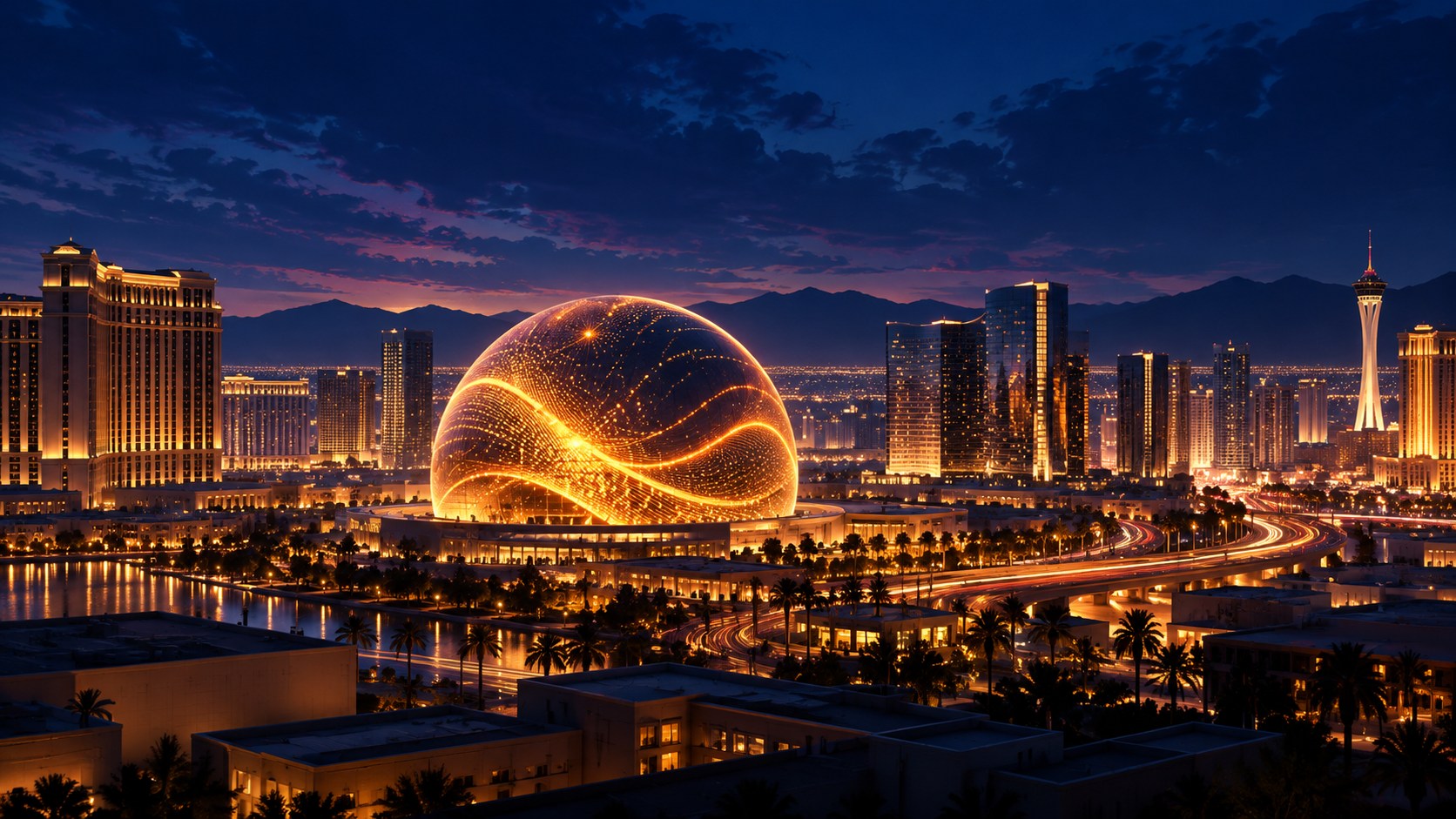
In autumn 2023, Las Vegas acquired two new images that suited its character while also signalling change. September brought the opening of Sphere, a vast spherical venue with a screen surrounding the audience. In November, Formula 1 cars took to a street circuit running along the famous Strip. A city whose identity had been shaped for decades by casinos and neon signs gained new reasons for people to travel halfway around the world. Sphere’s opening and F1’s return became events reaching far beyond the local calendar.
That is a useful starting point for understanding Las Vegas today. A concert, match, race or extraordinary screening can determine travel dates, the choice of hotel and the plan for an entire weekend. Casinos remain part of the picture, while the entertainment around them is increasingly building an appeal of its own. The most interesting question is how the city turns its surroundings into a spectacle that audiences are willing to travel to experience.
A city built around arrivals
Today’s scale can obscure the beginnings. Las Vegas traces its symbolic birth to 15 May 1905, when an auction of railway land began. A connection between southern California and Salt Lake City made the settlement a stop on an important route. Access to water helped serve trains and travellers. The city’s story therefore began with a very practical reason to stop here.
The 1930s brought another impulse. Clark County issued its first gaming licence in 1931. During the same period, construction of Hoover Dam attracted workers and stimulated the local economy. El Rancho Vegas opened in 1941 as the first themed hotel and casino resort on the road that would become the Strip. This chronology appears in the city’s official history.
A consistent theme runs through this history: Las Vegas grows by creating new reasons to visit. Initially, its location on a route mattered most. Later, what awaited visitors on arrival became increasingly important. Sphere and major sporting events can be seen as another chapter of the same story.
Sphere turns a building into a spectacle
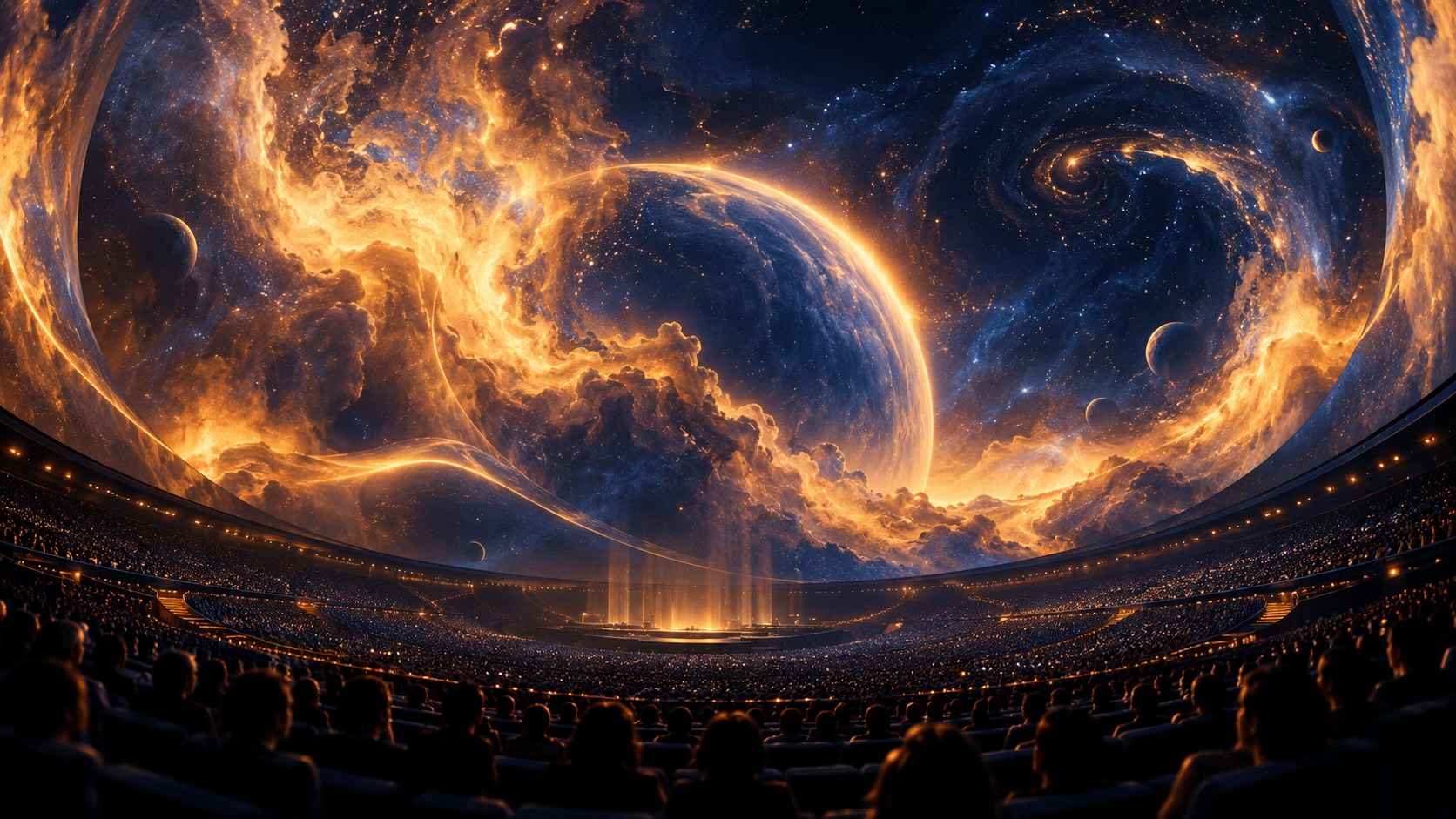
Sphere opened on 29 September 2023. Its interior has an LED surface of approximately 160,000 square feet, or nearly 14,900 square metres. The screen extends above and around the audience. The exterior, named the Exosphere, has roughly 580,000 square feet of LED surface - approximately 53,900 square metres. The venue’s technical specifications illustrate the scale of the project.
This structure changes the relationship between viewer and image. In a conventional auditorium, the screen is easily distinguished from its surroundings. Here, the image occupies a much larger part of the field of vision. The scenery can become a space in which the audience spends time.
The exterior is equally intriguing. A concert venue normally has to be visited to discover what is happening inside. Sphere itself becomes a display. It can be interpreted as a huge Las Vegas landmark that represents the city even when viewed from a distance or in a recording.
It is a contemporary expression of an ambition previously embodied in neon: catch the eye and make a place memorable.
A concert as a reason to travel
Sphere’s opening featured U2:UV Achtung Baby Live At Sphere. According to the organisers, the residency comprised 40 evenings, from 29 September 2023 to 2 March 2024. This particular show was available specifically in Las Vegas. The history of U2’s performances demonstrates how closely a performance can be tied to a location.
A residency is a series of concerts in one venue. Rather than successive cities on a tour, there is one stage to which the audience travels. In an exceptional auditorium, this model allows visuals and scenery to be designed for a particular space. The building itself becomes part of the artistic idea.
For a visitor, this also changes the order of decisions. The concert can be chosen first, with flights and accommodation arranged afterwards. In this scenario, the performance organises the whole trip: it sets the date, builds anticipation and becomes its most important memory.
That is the potential of Las Vegas as a destination for concert residencies. The city can gather audiences around a show created specifically for a particular venue. Its advantage becomes an experience that cannot be transferred in an identical form to just any building.
Cinema that surrounds the viewer
Sphere’s ambitions also include film. The Wizard of Oz at Sphere was announced for 28 August 2025. It was developed with Warner Bros. Discovery, Google and Magnopus. The classic film, originally intended for a 4:3 screen, was adapted to the enormous surface surrounding the audience. The experience includes seats that transmit vibrations, environmental effects and scents. The project description and the show’s website reveal the direction of these changes.
Such a project opens an interesting discussion about the boundary between a film and a spatial attraction. Traditionally, the frame selects what the viewer should see. Extending the image into the surroundings changes the way attention is focused. It also raises questions about how many new elements can be added while preserving the original’s character.
Technology alone does not determine the value of the experience. A huge screen gives creators new possibilities, but it needs an idea that justifies its scale. That is what makes this experiment interesting: Las Vegas becomes a place to explore how audiences respond to cinema that goes beyond an ordinary screening.
The Strip becomes a Formula 1 circuit
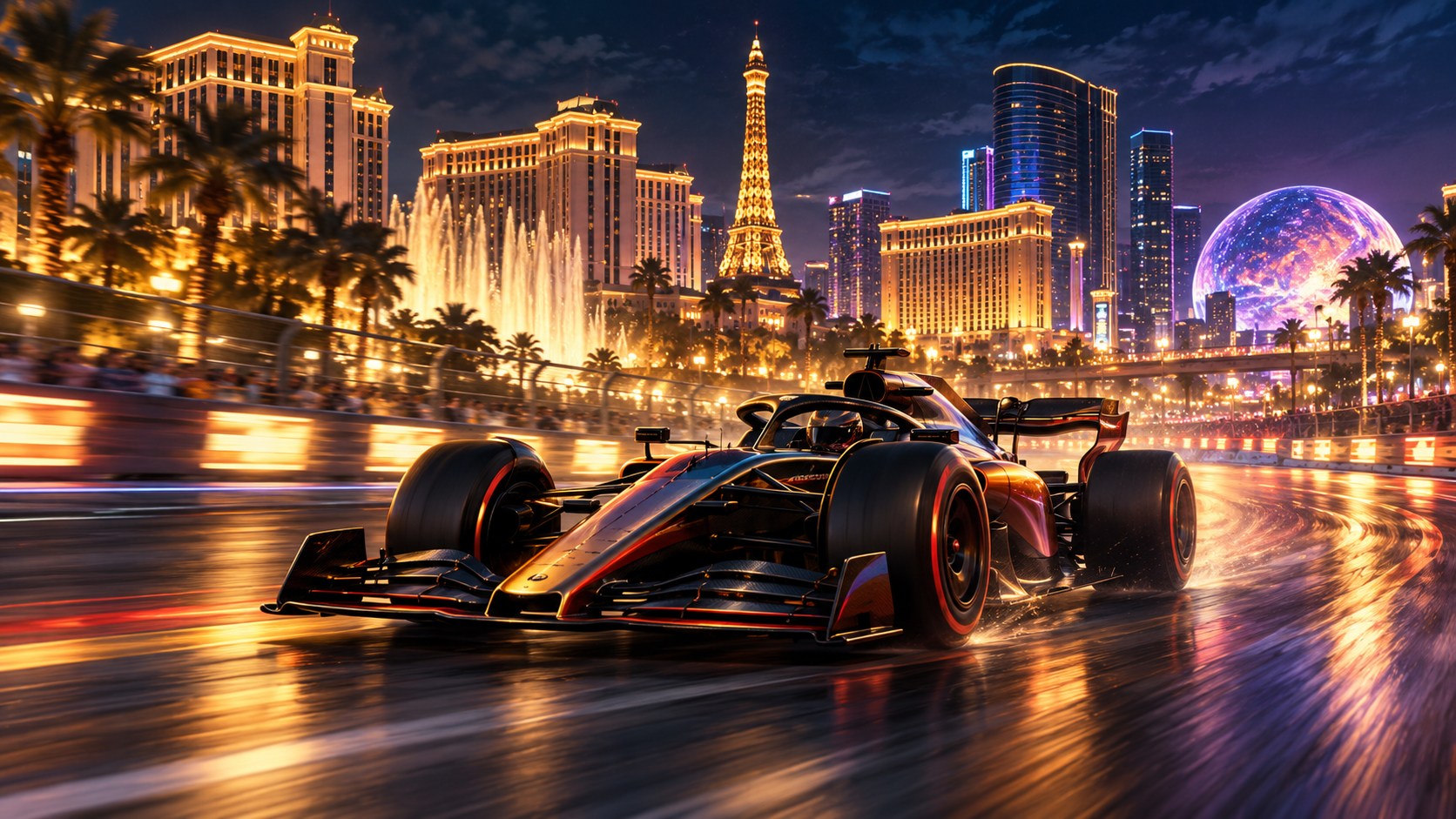
Formula 1 uses Las Vegas’s space in a different way. The street circuit is approximately 6.2 kilometres long and passes recognisable landmarks including Bellagio, Caesars Palace and The Venetian. The current Grand Prix joined the calendar in 2023. In June 2026, an extension was announced that is intended to keep the race in the city through 2037. These details come from F1’s official announcement.
It is worth examining what happens beyond the sporting competition. As the cars race down the Strip, the city’s architecture becomes the backdrop to the broadcast. The image of Las Vegas is combined with speed, sound and the tension of a race. This can be understood as a particularly intense way of presenting the city to a global audience.
Turning streets into an event venue also requires attention to how that space functions day to day. The spectacle has to be considered alongside traffic management, accessibility and the needs of people working locally. Viewers’ assessment of the event may differ from an assessment of its impact on city life.
The long agreement gives Las Vegas time to develop this format. Its quality will depend both on competition on the track and on the ability to fit the event into the city’s rhythm.
Sport broadens the Las Vegas story
Another powerful symbol is Allegiant Stadium. It hosted Super Bowl LVIII on 11 February 2024, with Usher performing at halftime. The event programme shows how closely sport and major musical entertainment meet.
This combination matters particularly to the city. A match attracts fans, a concert creates a different set of emotions, and together they form an event discussed even by people who follow sport only occasionally. Las Vegas can consequently play several roles at once: host of a competition, stage for performers and meeting place.
It could be argued that the ability to bring different audiences together is one of its most interesting strengths. Music enthusiasts and sports fans arrive for different reasons but use similar hotel and restaurant infrastructure.
In this model, the calendar also helps build the city’s significance. Different events can give it successive rhythms and make the same space feel different on each occasion.
Conferences sustain everyday activity
Major spectacles are easy to remember. Conference business is less spectacular but very important. According to the Las Vegas Convention and Visitors Authority, the city welcomed around 38.5 million visitors in 2025, 7.5 per cent fewer than in 2024. Convention attendance, meanwhile, was approximately 6 million, remaining close to the previous year’s level. These are figures for the full year 2025, published in January 2026.
These numbers remind us that the popularity of a single event and the health of an entire destination are different matters. Sphere can command attention while the city simultaneously faces weaker visitor traffic. The stability of the conference segment also suggests the importance of attracting people for different reasons.
Seen in this light, restaurants, meeting rooms and hotels take on a significance that a short race video cannot show. They provide the infrastructure that makes visits possible throughout the year. Without them, even the most spectacular evening would remain an isolated event.
Scale also needs to be judged from the visitor’s perspective
The decline in visitation encourages caution about the simple assumption that additional attractions automatically mean more tourists. The figures alone do not establish a single cause of the change. It cannot be attributed to one event or treated as proof that a new venue has failed.
They do, however, invite a practical question about the whole travel experience. A guest buying a ticket for an exceptional concert still has to reach the city, find accommodation, eat and move between venues. From that guest’s perspective, the quality of the trip emerges from all these elements. The memory of an excellent performance can therefore coexist with disappointment about another part of the stay.
This is a challenge for destinations that build their appeal through spectacle. Scale raises expectations. If the evening itself is meant to be exceptional, the services around it also need to work convincingly. A long wait or difficult journey can occupy a substantial place in the memory, even when the stage looked impressive.
Las Vegas’s development is therefore best assessed from two perspectives. One concerns new technical and artistic possibilities. The other concerns the ease of using the city. Together, they allow us to ask whether a visitor will want to return.
The Neon Museum preserves the city’s memory
Alongside the futuristic Sphere is a Las Vegas that wants to preserve its past. The Neon Museum was founded in 1996 to conserve and display historic signs. In the outdoor Neon Boneyard, signs tell the stories of the places they advertised and the people behind their creation. The visitor centre occupies the saved lobby of the former La Concha motel, originally built in 1961. The museum’s history connects architectural preservation with memories of the city’s entertainment.
This is particularly interesting in a place so strongly associated with change. A sign once designed to draw people into a hotel becomes, years later, a reason to visit in its own right. A functional object turns into evidence of the tastes, technology and ambitions of its era.
The museum also shows that urban development need not mean forgetting previous chapters. The Las Vegas story has room both for an image displayed on a giant sphere and for an old glass neon tube. Both served a similar purpose: persuading a passer-by to slow down and look.
The future of entertainment needs a place and a story
Bringing Sphere, concert residencies, sport and historic neon together leads to an interesting observation. Las Vegas is developing entertainment in which location is part of the experience. The auditorium, surrounding architecture, presence of other spectators and atmosphere of a particular evening all matter.
In a world full of recordings and broadcasts, this could be a significant direction. A short video shows a fragment of a spectacle but cannot convey every sensation associated with the venue’s scale and participation in the event. That difference can create a desire to visit, provided the experience itself fulfils the promise.
The largest screen alone cannot produce the best show. Sport needs exciting competition, a concert needs a good performance, and a film needs a story worth following. Technology expands the possibilities. How those possibilities are used will determine whether audiences want to experience them again.
Las Vegas has a fascinating continuity in this respect. A railway stop, a hotel sign, a concert stage and a street circuit belong to different eras, yet each helped give this place a reason to feature in travellers’ plans. Today, the city is working on more such reasons. The most interesting question is which of them will remain in people’s memories long after the screen goes dark.
Readers' voices
Add your perspective, relevant context or a question about this story.
No one has commented on this material yet. You can be the first.